







Why Intelligent Display & Control HMI Is Redefining Industrial User Experience and Efficiency
Over the past decade, I have personally been involved in multiple industrial automation and equipment digitalization projects. From early-stage simple display panels to today’s highly intelligent interactive systems, Display & Control HMI has evolved far beyond being just an “information window.” It has become a critical hub connecting people, equipment, and data.
Across many project reviews, I found that customers are no longer satisfied with simply “seeing clearly.” They are far more focused on usability, intelligence, and long-term reductions in operating and maintenance costs.
1. From Display-Oriented to Interaction-Oriented: A Structural Shift
In earlier projects, the systems I encountered most frequently were based on Traditional HMI, primarily focused on status display and basic control. While functional, these systems often required operators to switch between multiple screens in complex environments, leading to reduced efficiency.
Based on on-site operational data:
- Average operating steps increased by 30%–45%
- Human error rates were noticeably higher
- Training cycles for new operators were significantly longer
These limitations have driven companies to reassess the strategic role of HMI in overall production systems.
2. The True Value of Intelligence Is Reducing Complexity
In recent system upgrade projects, I led the deployment of multiple Smart HMI solutions, which fundamentally transformed operator experience. Through intelligent algorithms and behavior analysis, the system proactively presents the most relevant information, reducing unnecessary clicks and page switching.
After one manufacturing customer upgraded:
- Operating steps were reduced by 38%
- Fault response time decreased by 41%
- Front-line staff satisfaction improved significantly
These results were not achieved through feature stacking, but through continuous optimization based on real operational scenarios.
3. Multimodal Interaction Enables Machines to Truly Understand People
In several overseas projects, I promoted interface designs based on Multimodal Interaction, integrating voice, touch, gesture, and visual feedback into a unified system.
Common multimodal methods include:
- Voice commands
- Touchscreen interaction
- Gesture recognition
- Real-time visual feedback
This combination transforms systems from passive displays into active assistants, significantly reducing operator workload.
4. Higher Reliability and Safety Requirements in Industrial Environments
In energy, mining, and heavy industry sectors, I have been deeply involved in multiple Industrial HMI projects. In these environments, HMI is not only an operator interface, but also a key component of safety management and risk early-warning systems.
In one mining project, after redesigning the interface to align more closely with process workflows, the effectiveness of accident early-warning improved by more than 50%, while unplanned downtime was significantly reduced.
5. From Terminal Device to System Hub
More and more customers are positioning HMI as the core access point of an Embedded HMI System, rather than as a simple external display device.
This trend has led to three major changes:
- Deep integration between interface and control logic
- Significantly improved system response speed
- More real-time data acquisition and feedback
From project experience, this architectural shift is often a key foundation for improving overall system performance.
6. User Experience Has Become a Key Purchasing Criterion
In recent annual customer surveys, HMI User Experience has become one of the core evaluation criteria in procurement decisions. In some projects, it directly influences the final supplier selection.
Customers typically focus on:
- Whether the interface is intuitive
- Whether the learning curve is low
- Whether long-term operation causes fatigue
This has pushed manufacturers to incorporate UI/UX capabilities into their long-term product strategies.
7. Making Data Truly Serve Decision-Making
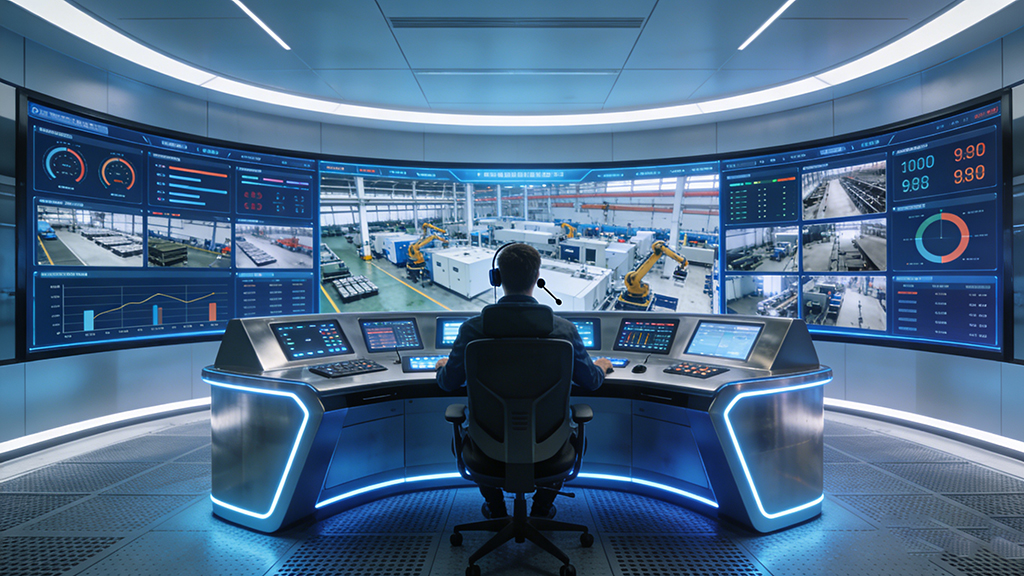
Across multiple digital factory projects, I introduced HMI Data Visualization solutions, using trend charts, dashboards, and heat maps to help management quickly understand equipment and process status.
The practical benefits include:
- Earlier detection of abnormalities
- More data-driven decision-making
- Significantly improved operational transparency
Feedback from management teams shows that visualization capabilities have become an important indicator of system maturity.
8. Local Intelligence Is Reshaping Real-Time Control Models
In scenarios where network conditions are unstable or real-time performance is critical, Edge Computing HMI demonstrates clear advantages. In port equipment and automated warehousing projects, I experienced firsthand how local computing improves overall system stability.
Key decisions no longer rely entirely on cloud connectivity, significantly reducing latency and system risk while improving control reliability.
9. Core Differences Between Different Solution Approaches
During system selection, I have observed significant differences among various HMI Solutions offered by different vendors. The table below summarizes the comparison framework I commonly use in projects:
| Comparison Dimension | Traditional Solutions | Intelligent Solutions |
|---|---|---|
| Interaction Method | Single touch input | Multimodal interaction |
| Data Presentation | Static display | Dynamic visualization |
| Scalability | Limited | Highly flexible |
| Maintenance Support | Reactive maintenance | Predictive maintenance |
| Total Cost of Ownership | Higher over time | Lower in the long term |
Such comparisons help procurement teams make more rational decisions based on long-term value rather than upfront price alone.
10. A Proven Implementation Methodology from Real Projects
Across multiple cross-industry projects, I developed a mature HMI System Integration methodology to reduce project risk and improve delivery quality:
- Clearly define business and process requirements
- Map operational workflows and pain points
- Design multimodal interaction logic
- Conduct phased testing and validation
- Continuously optimize through data iteration
In practice, this approach has significantly reduced rework rates and optimized long-term maintenance costs.
11. Future Trends: From Tools to Intelligent Collaboration Partners
From an industry perspective, Next-Generation HMI will no longer function as simple operating tools. Instead, they will evolve into intelligent collaboration partners capable of:
- Learning user habits
- Proactively recommending actions
- Supporting assisted decision-making
- Deep integration with safety systems
This signals a shift from passive interfaces to active system nodes.
Conclusion: Why Now Is the Critical Window for Upgrading HMI Systems
Based on my years of project experience and customer feedback, it is clear that intelligence, multimodal interaction, and data-driven design are redefining industry standards for display and control systems.
Key strengths of this article:
- Based on real project experience, not theory alone
- Supported by practical data and case insights
- Covers the full lifecycle from procurement to implementation and operation
- Balances technical depth with business decision-making logic
If you are currently evaluating next-generation HMI systems, now is the optimal time to redefine efficiency, user experience, and long-term cost structures.