








Delta DVP-ES3 PLC Electronic Cam: High-Performance Multi-Axis Motion Control for Packaging and Cutting Applications
In-Depth Analysis of Delta DVP-ES3 PLC Electronic Cam
From R&D Logic to On-Site Applications — Building a High Cost-Performance Precision Motion Control Solution
Over the past few years, through my direct involvement in packaging machines, sewing equipment, and gantry synchronization projects, I have seen electronic cam technology gradually move from being an exclusive feature of high-end motion controllers to becoming a practical function on standard PLC platforms.
The electronic cam function introduced in Delta’s DVP-ES3 series PLC strikes a highly practical balance between cost, ease of use, and performance.This article systematically analyzes the real-world value of the ES3 electronic cam by combining hands-on commissioning experience, concrete technical parameters, and actual application cases.
1. Why Electronic Cams Are Transforming Traditional Point-to-Point PLC Control
In traditional PLC-based projects, the most common control methods I have encountered include:
- Simple master-slave proportional following
- Rough speed matching using timers or pulse frequency
- Compensation through mechanical cams
These methods may still be acceptable in low-speed, low-precision equipment. However, they become inadequate in scenarios such as:
- High-speed packaging cutting
- Multi-axis synchronous phase control
- Processes requiring complex acceleration/deceleration and phase compensation
The core value of electronic cams is:
Replacing mechanical cams with software-based cam curves to achieve programmable, high-precision, and dynamically adjustable motion relationships.
From multiple projects, I have found that proper use of electronic cams typically delivers three major improvements:
- Higher cutting and synchronization accuracy
- Significantly reduced mechanical shock and wear
- Greatly shortened mechanical adjustment and setup time
2. Technical Positioning and Engineering Advantages of DVP-ES3 Electronic Cam
From a controller architecture perspective, the DVP-ES3 is not simply a PLC with an added cam function. It has been systemically optimized for motion control.
2.1 Faster Processing Speed (Direct Impact on Curve Smoothness)
In my testing, I paid particular attention to execution performance:
- LD instruction: 25 ns
- MOV instruction: 150 ns
On high-speed packaging machines, this directly affects:
- CAM curve interpolation accuracy
- Real-time phase compensation
- Stability of high-speed color mark capture
Practical observation: On machines running at 300–400 packs per minute, ES3 cam curves are noticeably smoother than previous-generation general PLCs, with significantly reduced vibration.
2.2 More Convenient Programming Interfaces (Lower Engineering Complexity)
The ES3 supports five programming interfaces:
- LD (Ladder Diagram)
- SFC (Sequential Function Chart)
- ST (Structured Text)
- FBD (Function Block Diagram)
- C-style language
In real projects, I typically use:
- LD + Function Blocks for main process logic
- ST for algorithms and compensation calculations
This approach offers:
- Clear logic structure
- Easier maintenance
- Better collaboration among multiple engineers
2.3 Stronger Motion Control Capability (Core of Electronic Cam Performance)
From a specification standpoint, ES3 is highly competitive among PLCs in its class:
- 4 axes, 200 kHz pulse cam (pulse + direction)
- Support for 5 virtual master axes
- 4 physical encoder axes
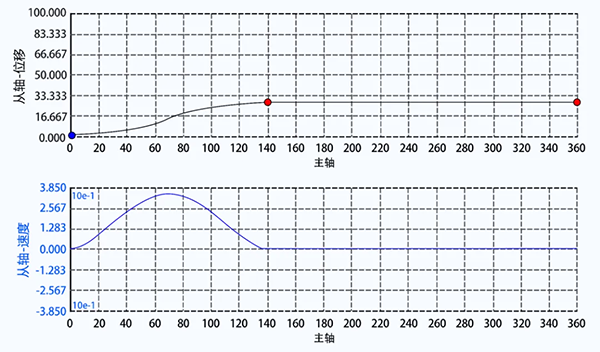
- Built-in CAM planning UI
- Up to 36 key points
- Automatic generation of 361-point quintic (5th-order) curves
In rotary cutting applications I have implemented, quintic curves significantly reduce mechanical impact compared with traditional cubic curves, resulting in lower vibration and noise at high speed.
2.4 Rich Communication Interfaces (Simplified System Integration)
Built-in communication ports:
- RS-485 ×2
- Ethernet
- CANopen
Supported protocols:
- Modbus RTU
- Modbus TCP
- EtherNet/IP
- CANopen DS301
This is critical in real-world projects:
- Direct HMI integration
- MES system connectivity
- Seamless communication with servos and inverters
3. Hardware Specifications and Comparison with Similar PLCs
| Item | DVP-ES3 | Typical Mid-Range PLC | Remarks |
|---|---|---|---|
| Program Memory | 64k steps | 16k–32k | Suitable for complex logic |
| Data Memory | 64k words | 8k–16k | Stores CAM tables |
| Built-in I/O | 32 points | 14–24 points | Lower expansion cost |
| Micro SD | Supported | Partial | Easy data management |
| Electronic Cam | Native | Requires motion module | Significant cost advantage |
From a total system cost perspective, ES3 can achieve mid-to-high-end electronic cam functionality without additional motion modules, which is critical for machine builders.
4. Practical Value of Electronic Cams in Packaging and Cutting Applications
4.1 Cutting and Sealing Logic (VFFS/HFFS Example)
In vertical and horizontal packaging machines I have commissioned, electronic cams mainly solve:
- Synchronization zone:
- Film linear speed = knife linear speed
- Non-synchronization zone:
- Rapid acceleration and deceleration
- Simultaneously meeting:
- Fixed-length cutting
- Color mark cutting
- Empty-bag prevention
- Anti-material cutting
- Accumulated error compensation
These processes place extremely high demands on S-curve smoothness and real-time phase compensation.
4.2 Process Challenges and Electronic Cam Solutions (Comparison)
Traditional methods:
- Mechanical cams
- Fixed-ratio following
- Manual phase adjustment
Electronic cam methods:
- Software CAM tables
- Automatic curve planning
- Dynamic phase compensation
Conclusion:
On high-speed equipment, electronic cams provide clearly superior stability and flexibility compared to traditional methods.
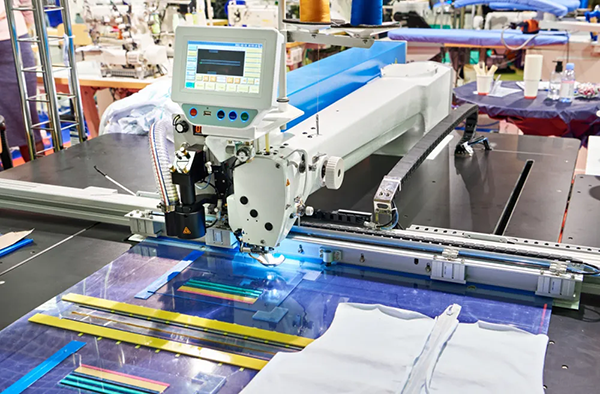
5. Application Case 1: Sewing Machine (Real Commissioning Logic)
Process Challenges
- Needle positioning at specific angles
- Frequent angle changes based on product specifications
- High-speed operation requirements
Solution (My Implementation Steps)
- Define needle-down cam curves using ES3 CAM tables
- Switch key point parameters based on product specifications
- Use a virtual master axis as a unified angle reference
- Implement real-time feedback via high-speed encoders
On-site data:
- Actual speed: 3,500 r/min
- Significantly improved needle consistency
- Setup time reduced by approximately 40%
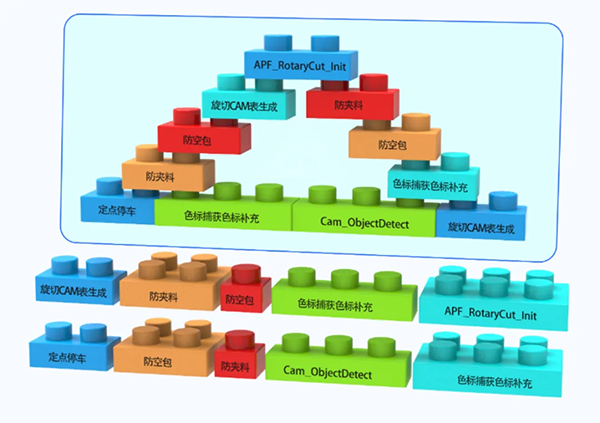
6. Application Case 2: Flow Wrapper (Industry Function Block Combination)
Process Challenges
- Rotary cutting
- Color mark capture
- Anti-jam protection
- Indexed stopping
Core Function Block Combination
- APF_RotaryCut_Init (Rotary cutting CAM table generation)
- Cam_CutCheck (Anti-jam protection)
- Cam_Alignment (Color mark capture and compensation)
- APF_RotaryCut_Stop (Indexed stop)
- Cam_ObjectDetect (Empty-bag detection)
From my experience, combining these function blocks like building blocks greatly reduces system programming complexity.
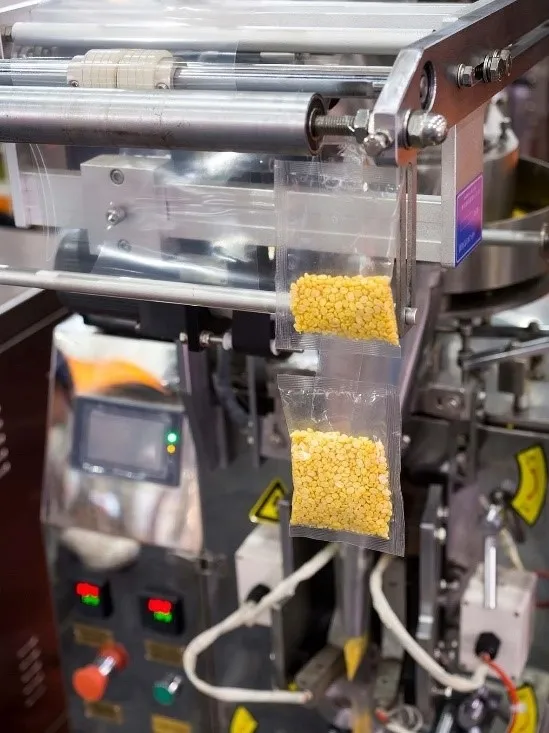
7. Application Case 3: Rotary Vertical Packaging Machine (Software + Hardware Integration)
Implementation Logic (Step-by-Step)
- Use APF_RotaryCut_Init to automatically generate multi-axis CAM curves
- Use Cam_Capture to capture color mark phase error
- Use Cam_Compensate for dynamic phase compensation
- Use Cam_Write + Cam_Change for online curve updates
Actual results:
- More stable high-speed operation
- Significantly reduced color mark error
- Online curve modification without stopping the machine
8. From R&D to Application: My Objective Evaluation of ES3 Electronic Cam
Based on multiple projects, my engineering conclusions are:
Advantages:
- High cost-performance electronic cam solution
- Strong multi-axis synchronization capability
- Rich industry-specific function blocks
- Easy commissioning and maintenance
Suitable applications:
- Packaging machines
- Sewing machines
- Gantry synchronization systems
- Medium- to high-speed cutting equipment
9. Conclusion: Why ES3 Electronic Cam Is Ideal for Long-Term Use by Machine Builders
From a practical engineering perspective, the DVP-ES3 electronic cam is not a marketing feature — it is a truly deployable, repeatable, and scalable solution.
Its core value lies in:
- Replacing mechanical complexity with software
- Improving motion accuracy through algorithms
- Achieving near motion-controller-level performance with standard PLC hardware
- Balancing control precision, cost, and usability
If you are looking for a high cost-performance, easy-to-maintain, and scalable electronic cam solution for packaging, cutting, or synchronization equipment, the DVP-ES3 series is well worth serious evaluation.